

Real-Time Rendering vs Traditional Rendering — Which One Should You Choose?
Real-Time Rendering versus Classical Rendering – Which One To Choose?
The decision to go with real-time rendering or traditional rendering can make or break your whole project schedule. Real-time rendering wins if you want instant feedback when you are designing. If you want photorealistic final images for cinema in contrast, traditional rendering is still the quality standard. At Studio3, we help our clients determine which pipeline is best for their project, and this guide explains how each one works.
What is Realtime Rendering?
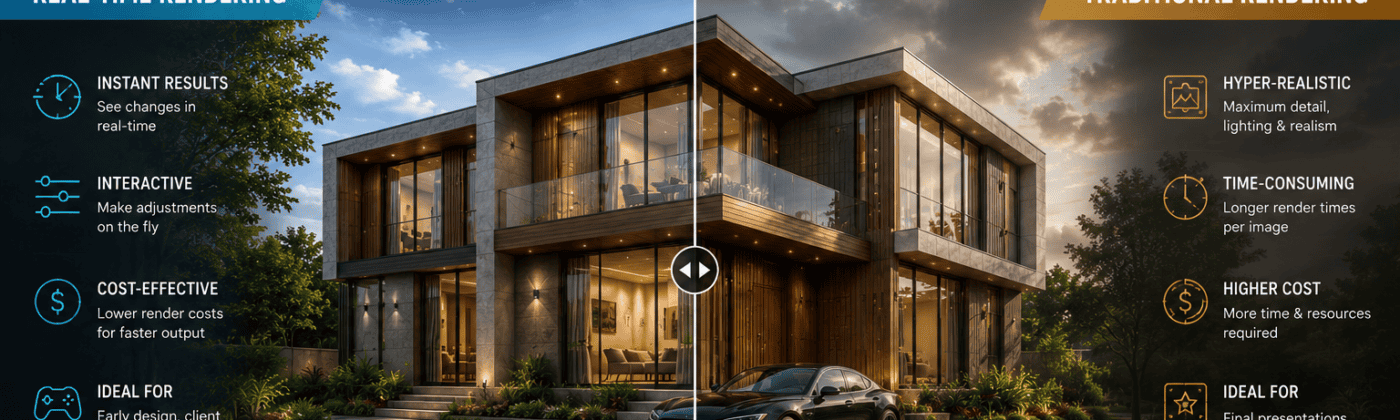
Real-time rendering creates images on the fly as you interact with a 3D scene. The viewport updates instantly as you move the camera, change a material, or tweak the lighting. 15-60+ times per second . Smooth and responsive .
The technology was originally developed in the gaming industry. Engines like Unreal Engine had to render millions of polygons per second without lagging the gameplay. Architecture and design firms later used the same method for client walkthroughs and design reviews.
Why Studios Use It
Real-time rendering can save a tonne of time in the design phase. Studio3 often uses real-time pipelines for early client presentations where teams can adjust materials or layouts live, in front of a client. That means feedback loops change from days to minutes.
What is Classic Rendering?
In traditional rendering, also called offline or ray-traced rendering, the light bounce is calculated one bounce at a time. We trace each ray of light through the scene , reflect it off surfaces , and measure how accurate the result is . It’s a process that creates stunning realism, but it takes time — often minutes or hours for a single image.
This is what software such as V-Ray or Corona uses. So, for final marketing stills, hero shots and cinematic sequences where every detail counts, traditional rendering is still the way to go.
When Accuracy Is Everything
If a client needs a photorealistic image for a brochure, website or investor pitch, traditional rendering will typically provide a better result. And the extra render time is worth it for the richer shadows, more accurate reflections and finer texture detail. This is not the way Studio3 normally recommends to do final deliverables, but rather to do early concept work.
Ray Tracing vs Real-time. What’s the Technical Difference?
The ray tracing vs real time debate usually boils down to one trade off, speed vs precision.
1. Light Accuracy Ray tracing computes light physics as it happens in real life . Real-time engines compute light physics in a few different ways , like baked lighting , or hybrid ray tracing .
Hardware requirements: For conventional ray tracing you need powerful CPUs or render farms. Real-time rendering is done on modern GPUs instead.
Real-time rendering produces results immediately, whereas traditional rendering can take hours to produce a single high-res frame.
Use case fit: Live game reviews & walkthroughs. Classical rendering is for the final, finished look.
So simply put, ray tracing vs real time isn’t really a fight. It’s a matter of what phase of the project you’re in, rather.
Hybrid Workflows Are Becoming the New Normal
Many studios, including Studio3, are now blending both approaches. Teams use real-time rendering to iterate fast on designs, and then use traditional rendering for the final images that are shown to clients. This hybrid workflow combines the best of both worlds, speed during development and realism at delivery.
Unreal Engine Architecture and Why It Matters
Real-time rendering is one of the main reasons why Unreal Engine architecture has become so popular outside of gaming. Its rendering pipeline is a combination of a few technologies working in unison to produce near photoreal results in real time.
Lumen supports dynamic global illumination, so lighting updates automatically as objects move.
Nanite “Virtualized Geometry” technology allows for massive amounts of geometric detail without tanking performance. You can render highly detailed 3D models with smooth performance.
Hybrid ray tracing blends rasterisation with a few ray-traced elements to add realism, but not at the full cost of offline rendering.
This is true for Architectural and Product Visualisation
Unreal Engine architecture enables both speed and visual fidelity, so studios use it for interactive walkthroughs, VR experiences and live client presentations. Studio3 uses this same architecture when clients want to walk through a space before they commit to final renders. Thus teams can get work done faster without sacrificing too much on visual quality on the review stage.
Real-Time Rendering vs Traditional Rendering: A Side-by-Side Comparison
| Factor | Real-Time Rendering | Traditional Rendering |
|---|---|---|
| Speed | Instant (15–60+ FPS) | Minutes to hours per frame |
| Hardware | GPU-driven | CPU or render-farm heavy |
| Best for | Walkthroughs, reviews, VR | Final marketing images, cinematics |
| Realism | Very good, improving fast | Highest available today |
| Cost over time | Lower for iteration | Higher for final-frame polish |
Which one do you choose?
The right option is entirely dependent on your project phase and objectives.
Opt for real-time rendering for rapid client feedback, interactive walkthroughs or VR previews in the design process. Choose traditional rendering if you are after a perfect, photorealistic image for marketing, publication or a final presentation. And if your project has to be fast and polished, a hybrid pipeline usually gives the best result.
Studio3 works with clients in all three of those scenarios. Our team reviews your timeline, budget and end goal prior to suggesting a pipeline to make sure you never pay for more render time than your project needs.
Ready to Pick the Right Rendering Pipeline?
Choosing between real-time and traditional rendering doesn’t have to be hard. Studio3 can take you through the complete rendering pipeline for architecture, product design or game environments whether you need instant walkthroughs, final photoreal stills or a hybrid approach that combines both.
Contact Studio3 today to discuss your next project and discover which rendering style—real-time, traditional, or hybrid—best suits your goals, budget, and timeline.